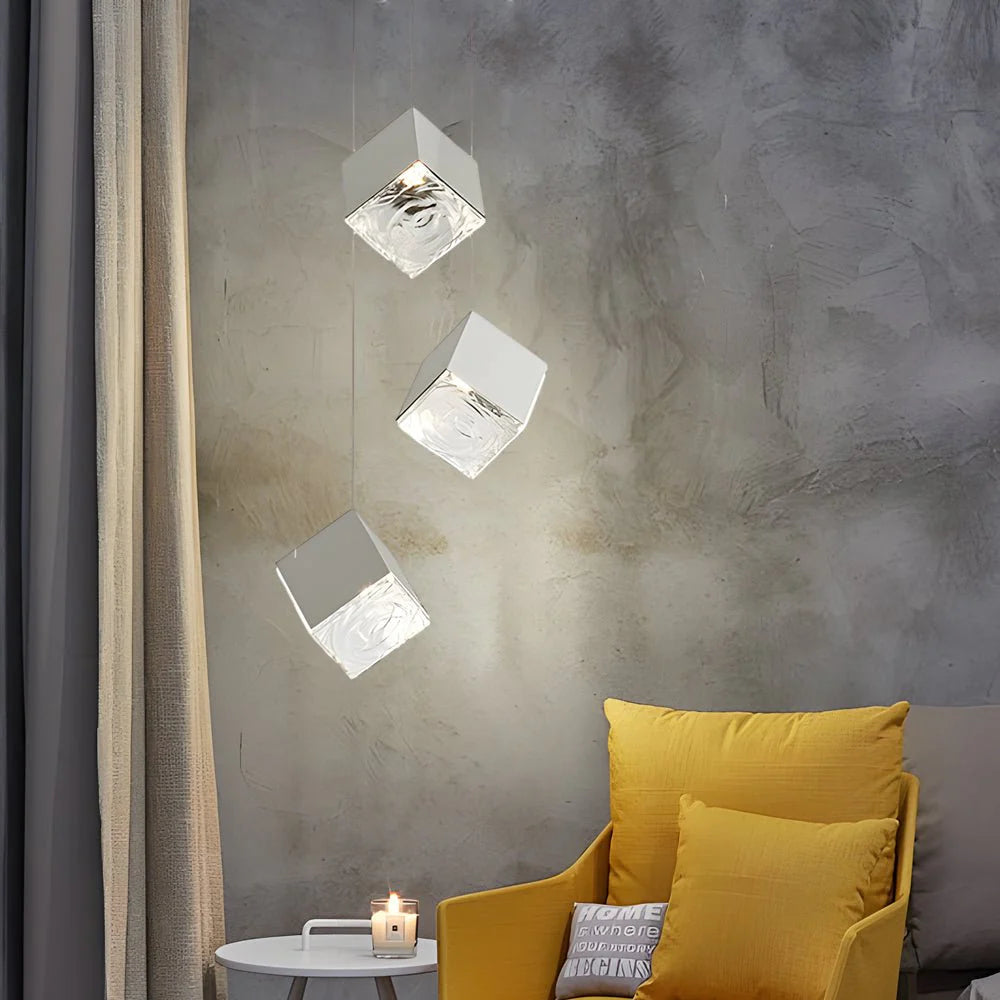
Size a stairwell chandelier from four numbers: floor-to-floor height, the width of the void, the walking line beneath, and the fixture’s published maximum hang. Keep the lowest point at least 90 in. (7 ft 6 in.) above the tread, and budget roughly two-thirds of the void for the body-plus-drop assembly.
A stairwell fixture is judged from three places at once: the entry door, the landing, and directly underneath. Getting it right is mostly a matter of dimensions and one structural decision.
What do you measure first in a stairwell?
For a stairwell you need four numbers: floor-to-floor height, the width and length of the void, and the height of the opening at each level. Ceiling height alone is not enough, because the fixture hangs through the void rather than below a ceiling.
- Clearance: the lowest point should clear the walking line by at least 7 ft 6 in. Over a stair flight, measure vertically from the tread directly below the fixture.
- Proportion: in a double-height void, go one size larger than a single-height room of the same footprint. Voids swallow small fixtures.
- Sightline: check the view from the front door. The fixture should sit in the void, not overlap the top of the doorway in the sightline.
Most US residential codes put stair headroom at 6 ft 8 in. (203 cm) over the tread nosing, and the International Residential Code is the model most states adopt — but the rule that governs your job is whatever the local authority having jurisdiction has adopted, so treat 90 in. as the design target and confirm the code floor with your inspector.
The table below converts a floor-to-floor dimension into a drop budget. It assumes the fixture hangs from the upper ceiling and the walking line below is the lower floor; subtract the fixture body height from the drop to get the chain or rod length you actually order.
| Floor-to-floor | Void height | Max total drop at 90 in. clearance | Recommended body + drop | Fixture body | Chain or rod to order |
|---|---|---|---|---|---|
| 12 ft | 144 in. | 54 in. | 40–48 in. | 18–24 in. | 16–30 in. |
| 14 ft | 168 in. | 78 in. | 56–68 in. | 24–30 in. | 32–44 in. |
| 16 ft | 192 in. | 102 in. | 72–88 in. | 30–42 in. | 42–58 in. |
| 18 ft | 216 in. | 126 in. | 90–110 in. | 42–48 in. | 48–68 in. |
| 20 ft | 240 in. | 150 in. | 108–130 in. | 48–60 in. | 60–82 in. |
| 24 ft | 288 in. | 198 in. | 140–170 in. | 60–72 in. | 80–110 in. |
Above 16 ft you are usually in custom-drop territory: the longest maximum hang published on our own spec sheets is 195 in., on a piece with a 47.75 in. body. If your void needs more than that, it is a drawing job rather than a catalogue order. The room-level rules for single-height spaces are on the chandelier size chart, and the arithmetic behind them is in how to size a chandelier.
Is your ceiling structure rated for the load?
Large stairwell pieces are heavy. Alabaster and crystal assemblies routinely exceed 100 lbs and can exceed 250 lbs for multi-tier frames. That load has to reach structure — usually a beam or a purpose-built fixing above the ceiling line, not a plaster ceiling with a light box.
Decide this before the ceiling is closed. If the structure is already finished, the practical options are a smaller fixture, a chain hung from an existing structural point, or a canopy designed to spread the load across two joists.
Of the 835 products on this site, 69 publish a shipping weight. The median is 25 lbs, which is not the number to worry about; 22 of those 69 are over 60 lbs and 12 are over 100 lbs. The heaviest single piece currently listed is 425 lbs on a 64.5 in. frame with a 15 in. canopy — that is a structural steel conversation, not a ceiling-box conversation.
| Published fixture weight | What it needs above the ceiling | How common in the catalogue |
|---|---|---|
| Under 25 lbs | Box rated for the fixture, swivel to a joist | 31 of 69 published weights are under 20 lbs |
| 25–60 lbs | Fan-rated box, or a brace spanning between joists | 16 of 69 fall in the 20–60 lbs band |
| 60–100 lbs | Independent structural fixing, load spread across two joists | 22 of 69 are 60 lbs or more |
| 100–425 lbs | Engineered fixing to a beam or steel member, signed off by the project engineer | 12 of 69 are 100 lbs or more, up to 425 lbs |
How long a chain or rod does a double-height void actually need?
Two numbers on a spec sheet look similar and mean different things, which is where most stairwell orders go wrong.
- Fixture height is the body alone, measured top of frame to bottom finial.
- Overall hang is body plus chain, cord or rod, measured from the ceiling to the lowest point. This is the number that has to fit your void.
Here is how that reads on four pieces currently listed, with the published figures unchanged:
| Model | Body height | Overall hang | Chain, cord or rod | Canopy | Weight | Current price |
|---|---|---|---|---|---|---|
| Lylo Nautilus Glass Disc Pendant | 47.75 in. | 195 in. max | 10 ft cord | 5.12 in. | 32.6 lbs | $3,060 |
| Geode Metal Six-Light 44¼″ | 48.75 in. | 52–192 in. adjustable | 141 in. chain | 4.75 in. | 18.7 lbs | $1,528 |
| Tanorlen Smoke Round Chandelier 65″ | 28 in. | Rods: six 6 in., twelve 12 in., six 18 in. (288 in. of rod stock) | Rod | 15 in. | 425 lbs | $7,390 |
| Alabaster Cube Foyer Staircase Long, 36-light | 30.71 × 28.35 in. | Set on site | 6.56 in. cord | 27.17 in. | Not published | $1,480 |
Read the Tanorlen row carefully: 288 in. of rod ships in the crate, but the frame is only 28 in. tall, so the assembly tops out wherever the installer stops cutting rod. A 20 ft void needs 108–130 in. of total assembly, which is well inside that stock.
- Drop adjustment: most of our models adjust in 6 in. increments at the canopy with extra rod supplied free of charge, so the exact drop can be set on site rather than being fixed at the factory.
- Chain vs rod: chain suits traditional and multi-tier forms and allows fine adjustment; rod gives a cleaner line on modern pieces but has coarser increments.
- Wiring: confirm the driver or transformer location. On very long drops the driver is usually best mounted at the canopy rather than in the fixture body.
What canopy size does a tall void need?
In a tall void, a standard 5 in. canopy looks undersized. Larger canopies also house the extra chain and wiring more neatly. Canopy diameters across the current catalogue run from 4 in. to 24 in., with rectangular canopies of 22.44 in. to 27.17 in. on long staircase frames — the size to specify scales with the opening you are covering, not with the fixture body.
| Opening the canopy has to cover | Canopy diameter | Why this size |
|---|---|---|
| Up to 48 in. | 5–6 in. | Covers a standard box and the swivel |
| 48–96 in. | 6–10 in. | Hides the joist penetration and spare links |
| 96–168 in. | 10–15 in. | Houses the driver and 40–60 in. of coiled chain |
| Over 168 in., or multi-tier frames | 15–24 in. round, 22–27 in. rectangular | Spreads load, closes a large framed opening |
What should you send us to get a dimensioned drawing?
- A photograph or drawing of the void, including where the walking line passes.
- Floor-to-floor height and the width of the opening at each level.
- Destination country, so the fixture is built and wired for the right market, and so certification status can be confirmed before the order is placed.
- The finish you are matching, if any.
With those four things we return a dimensioned drawing and a render before anything is made. Start at chandeliers, or go straight to a custom stairwell request. Trade buyers working from a schedule of finishes can route the same request through the trade program.
Frequently asked questions
How high should a stairwell chandelier hang above the stairs?
Keep the lowest point at least 90 in. (7 ft 6 in.) above the tread directly below it, measured vertically. Where the fixture hangs into a landing rather than over a flight, measure from the finished floor instead. Anything below 84 in. will be struck by tall visitors carrying loads, so 90 in. is the working minimum on a stair.
How much chain do I need for a 20 ft foyer?
A 240 in. void with 90 in. of clearance leaves 150 in. of total drop. Budget 108–130 in. of assembly, then subtract the body height: a 48 in. body needs 60–82 in. of chain. Order the chain at the top of the range rather than the middle, because links can be removed on site but not added.
Can a 425 lb chandelier hang from a standard ceiling box?
No. A standard box is rated for the fixture weight and a few pounds of hardware, typically well under 50 lbs, and nothing in a residential ceiling box is designed for 425 lbs of static load plus the dynamic load of installation and cleaning. That weight needs an engineered fixing to a beam or steel member, specified by the project engineer before the ceiling closes.
Why is the fixture height different from the hang height on your spec sheet?
Fixture height measures the body only; hang height measures ceiling to lowest point including chain, cord or rod. The Lylo Nautilus is 47.75 in. of body but reaches 195 in. overall at full extension, so the two numbers differ by more than 12 ft. Always size the void against the hang height and cut the chain to the body.
Prices quoted above are the current site prices and move during promotions; confirm the price at the point of order.