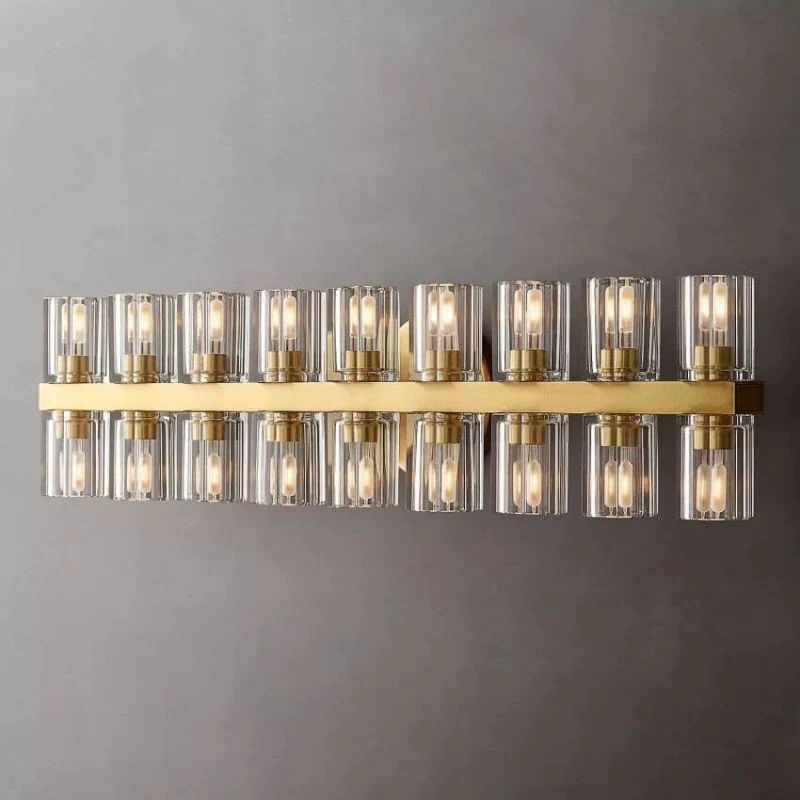
A 110–120V fixture and a 220–240V fixture are different builds, not the same fixture with a different plug. The driver, sockets, conductor insulation, canopy and certification all change with the supply voltage. Tell the supplier the destination country, not the voltage, and confirm the socket before the order is released.
What actually changes between a 110V build and a 220V build?
Five components change, and only one of them is visible from the outside. The plug is the part everyone asks about; the four parts nobody asks about are the ones that decide whether the fixture passes inspection.
- Drivers and LED components. Constant-current drivers are voltage-specific. A 220V driver run on 110V will under-drive the LEDs; the reverse will damage them.
- Wiring and insulation. Conductor sizing and insulation rating change with supply voltage.
- Sockets. E12 candelabra for North America, E14 for Europe; G9 in both but different lamp options.
- Certification. UL 1598 / ETL for North America, EN 60598 CE marked for the EU, SAA on request. The certification belongs to the build, not to the model name.
- Canopy and mounting hardware. Junction box patterns differ between regions, and so do the fittings.
Socket type is the line most often left blank on a purchase order, and it is the one that stops an installation on the morning of the handover. Across the 835 products currently published on this site, the socket named in the product description breaks down as follows — this is site data, not an industry average:
| Socket | Products listing it | Share of catalogue | Where it is normally used |
|---|---|---|---|
| E12 candelabra | 370 | 44% | North American chandeliers and sconces with small glass shades |
| E26 medium | 111 | 13% | North American pendants, larger shades, exposed-lamp designs |
| G9 | 75 | 9% | Compact halogen or LED capsules, both regions |
| G4 | 21 | 3% | Low-voltage capsules in small pendants and picture lights |
| E14 small Edison | 13 | 2% | European equivalents of E12 fittings |
| E27 medium Edison | 10 | 1% | European pendants and table lamps |
| GU10 | 2 | <1% | Mains-voltage spots in track and surface fittings |
The wattage figures in the same descriptions cluster the same way: 40W appears in 98 products, 60W in 71, 25W in 70 and 5W in 65. Those are maximum ratings per socket, not the light output of the fixture — a 12-light chandelier rated at 40W per socket is a 480W load on the circuit, which is why the load calculation has to be done before the fixture is hung, not after.
Do US and EU projects need different sockets and different certification?
Yes, and the difference is not cosmetic. The United States and Canada run 120V at 60Hz with E12 and E26 fittings; the EU and the UK run 230V at 50Hz with E14 and E27. A fixture built for one market cannot be listed for the other by swapping lamps, because the listing follows the internal components.
| Destination | Supply | Socket normally specified | Typical lamp | Certification to confirm before ordering |
|---|---|---|---|---|
| United States — residential and retail | 120V, 60Hz | E12 candelabra, E26 medium | B10, A19 | UL 1598 or ETL, per build |
| United States — commercial 277V circuits | 277V, 60Hz | Same sockets, different driver | Depends on driver | Confirm the driver is rated for 277V, in writing |
| Canada | 120V, 60Hz | E12, E26 | B10, A19 | cUL or cETL, per build |
| European Union | 230V, 50Hz | E14, E27 | C35, A60 | EN 60598 CE marking, RoHS |
| United Kingdom | 230V, 50Hz | E14, E27 | C35, A60 | UKCA |
| Australia / New Zealand | 230V, 50Hz | E14, E27 | C35, A60 | SAA, on request |
277V is the one that catches people out. It is a standard commercial voltage in North American buildings — one leg of a 480V three-phase service — and a fixture specified for 120V will not run on it. Three products in this catalogue already reference a 277V driver in their description; for anything else, ask for the driver rating in writing. Ceiling heights and room dimensions are the other half of the same specification; the chandelier size chart gives the room-width and ceiling-height numbers that sit next to the voltage on a submittal.
Why retrofitting is a liability, not a saving
A 220V fixture fed through a 110V-certified canopy fails on two counts: the certification no longer applies to what was installed, and the electrical components are outside their rated conditions. On a commercial project that is an insurance and inspection problem. On a residential one it is a fire risk with no upside.
The arithmetic that makes retrofitting look cheap is always the same: one line item for a transformer or a rewire, against a build that would have cost the same at the factory. What the line item does not include is the second inspection, the schedule slip while the replacement is built, and the possibility that the authority having jurisdiction refuses to sign off on a fixture whose listing no longer matches the installation.
How do I specify voltage correctly on a purchase order?
Put the destination on the document, not the voltage. Voltage is an inference from the destination; when the inference is wrong, the document is wrong in a way nobody catches until the crate is open.
- State the destination country on the enquiry, not the voltage. “Project in Toronto” is unambiguous; “110V” is a guess that may be wrong for a commercial building.
- Confirm the certification required by the local authority having jurisdiction, and ask for the certificate before ordering if it is a commercial project.
- For mixed-market projects, split the order by destination and label the crates accordingly. We build and pack per market so nothing gets mixed on site.
- Keep the certification documents with the project handover pack. Inspectors ask for them.
| Check | Who confirms it | Document it should appear on | When |
|---|---|---|---|
| Destination country and supply voltage | Specifier | Purchase order line | Before quotation |
| Socket type per fixture | Specifier, confirmed by supplier | Approved spec sheet | Before production release |
| Driver input range, including 277V if applicable | Supplier | Driver datasheet | Before production release |
| Certification file for this build | Supplier | Certificate PDF, model-referenced | Before shipping |
| Maximum load per circuit | Electrical contractor | Panel schedule | Before installation |
| Carton and crate labelling by market | Supplier | Packing list | At dispatch |
Are plugs and dimming the same question?
Plugs are only relevant for portable fixtures. Hardwired fixtures — the vast majority of chandeliers, pendants and sconces — connect through a junction box, so the plug question does not arise. For table and floor lamps we supply the plug for the destination market.
Dimming is the third question, and it is separate from both. Whether a fixture dims, and which control protocol the driver expects, has to be confirmed model by model against the dimmer already specified on the project. A fixture that is dimmable on a 120V build is not automatically dimmable on the 230V equivalent, because the driver is a different part.
Can a 220V fixture be rewired to 110V on site?
Not legitimately. Replacing the driver and the sockets on site produces a fixture that no longer matches its certificate, and the electrician who signs it off carries the liability. Order the correct build; the factory cost of doing so is close to zero compared with the on-site labour of converting one.
What voltage do US commercial projects actually use — 120V or 277V?
Both, in the same building. 120V serves receptacles and most residential-grade lighting circuits; 277V is the line-to-neutral voltage of a 480V three-phase service and is common for commercial lighting. Ask the electrical engineer which circuit the fixture lands on, and put that number — 120 or 277 — on the purchase order rather than the word “US”.
Does the voltage build change the price or the lead time?
The build configuration is part of the quotation, not a surcharge line. What moves the price is size, light count and finish: chandeliers on this site currently run from $149 to $15,027, with a median around $2,303, and pendants from $155 to $8,675. Production is 30 days for standard models and 30–45 days for custom dimensions or finishes after the drawing is approved, in either voltage. Prices shown are as currently listed on the site and change with promotions; confirm the figure on the quotation for the build you need.
Our standard catalogue is available in both build configurations; tell us the market when you request trade pricing or a quote, or read the support section on shipping and certification for how each market is handled. If the project needs a non-standard drop, a different socket or a finish match, the customisation options are set out separately. To see what the sockets above look like in practice, the chandelier range runs from 1-light to 36-light models — this 24-light crystal chandelier is an E26 build, which is the fitting to check first if your electrician is supplying lamps.