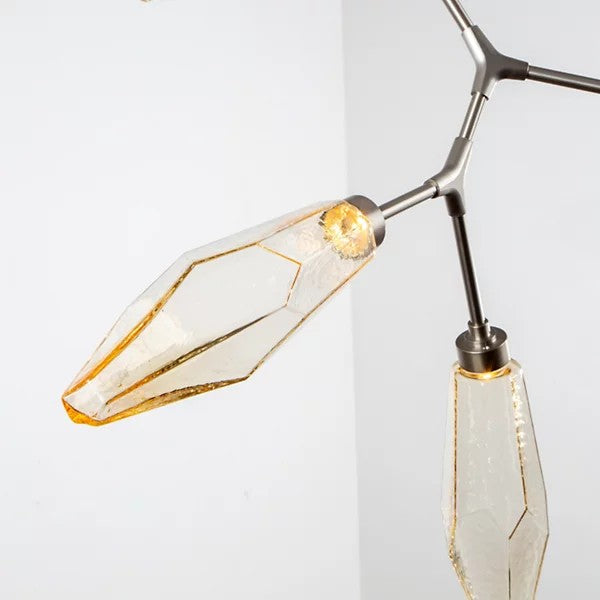
Alabaster, crystal and glass all diffuse light, but they behave very differently on site. The choice usually comes down to four things: how the light should feel, how much weight the structure can take, who maintains the fixture, and the budget band.
Which shade material should you specify — alabaster, crystal or glass?
Short version: choose alabaster or calcite when you want a soft, glare-free glow and the ceiling can carry stone; choose crystal when the client is buying sparkle and someone owns the cleaning; choose glass when you need even, neutral light, the lowest maintenance and the widest size range. If two of those apply, mix them — a brass frame with alabaster shades, or a glass body with a crystal trim detail, gives depth without doubling the maintenance burden.
| Material | How light comes through | Weight at the same silhouette | Cleaning effort | Suits |
|---|---|---|---|---|
| Alabaster & calcite | Glows through the veining — diffused, never a sharp beam | Heaviest of the three; stone shades dominate the load | Dry soft brush only. No solvents, no ammonia | Warm residential, boutique hospitality, spa |
| Crystal | Refracts and splits light into sharp, high-contrast highlights | Heavy and dense — plan both the ceiling fixing and the crate | Piece by piece on large bodies: a scheduled task, not an occasional one | Formal and statement interiors, lobbies, ballrooms |
| Glass | Transmits evenly; frosted and fluted options cut glare | Lightest at equal size | Wipe clean; nothing beyond dusting | Clean architectural, commercial, large-format, covered outdoor |
Exact shipping weights vary by size and light count, so we confirm them on the spec sheet at quote stage rather than quoting a single figure here. As a structural rule that does not change: above roughly 80 lb, plan a proper ceiling fixing and flag it on the enquiry — that changes the canopy, never the design.
How do alabaster and calcite actually light a room?
Alabaster is a natural stone. Cut thin, it glows rather than transmits — the light comes through the veining, so the fixture reads as a lit object rather than a bright lamp. No two shades are identical, which is exactly why it is specified in residential and boutique hospitality work.
- Light quality: warm, even, low glare. Excellent with 2700–3000K sources.
- Weight: heavy. A large alabaster chandelier can exceed 100 lbs — the structural fixing matters.
- Maintenance: dust with a dry, soft brush. Avoid solvents and ammonia.
- Best for: dining rooms, foyers, bedrooms, spas, restaurants.
Calcite behaves the same way but is denser and more translucent, so the veining reads harder and the fixture carries more presence. It is the scarcest of the four materials in our catalog and the most expensive at the median, which is why a calcite body in the same silhouette sits one price band above the alabaster version. A mid-size example is the Alabaster Feathery Chandelier at 40 in., and the same idea at larger scale is the Moira Alabaster Round Chandelier at 48 in.
What does crystal give you that the other two do not?
Hand-cut crystal produces the sharp highlights and refraction that hospitality lobbies and formal interiors are usually looking for. Because it is manufactured to a repeatable spec, a 60-light crystal chandelier can be extended or repaired years later and still match.
- Light quality: bright, high contrast, dramatic at night.
- Weight: heavy and dense — plan the ceiling fixing and the crate.
- Maintenance: periodic cleaning of individual drops; on large fixtures this is a scheduled task, not an occasional one.
- Best for: hotels, ballrooms, formal dining, retail flagships.
The trade-off is labour, not light. A 60-light crystal body can carry several hundred individual drops, and a single cleaning cycle on that fixture is measured in hours. If nobody on the client side owns that task, specify a glass body and keep crystal as a trim detail — you keep the highlight without inheriting the maintenance calendar.
When is glass the practical middle ground?
Mouth-blown and pressed glass give a clean, architectural look with more control over uniformity than stone and less maintenance than crystal. Glass is also the most forgiving for large-format fixtures and outdoor or semi-outdoor work.
- Light quality: even, neutral; frosted and fluted options cut glare.
- Weight: lighter than crystal or stone for the same silhouette.
- Maintenance: wipe clean; no special care beyond dusting.
- Best for: kitchens, islands, bathrooms, commercial corridors, covered outdoor areas.
It is also the only one of the three where near-identical repeatability across 20 or 30 units of the same fixture is routine. On a multi-unit residential or hotel package, that consistency is worth more than the sparkle you give up — a 47 in. clear glass round chandelier and the thirtieth copy of it should be indistinguishable on site.
What do these materials actually cost?
Material carries a price band, and the band is wider than most people expect. These are the live bands for chandeliers in our own catalog, by material keyword:
| Material | Chandeliers listed | Entry price | Median price | Highest listed | Median vs glass |
|---|---|---|---|---|---|
| Alabaster | 64 | $336 | $2,198 | $15,027 | 1.13× |
| Calcite | 7 | $2,303 | $4,858 | $10,788 | 2.49× |
| Crystal | 78 | $258 | $1,778 | $13,318 | 0.91× |
| Glass | 65 | $231 | $1,950 | $8,455 | 1.00× (baseline) |
Two things stand out. Entry prices are close together — a small glass pendant starts at $231, a small crystal body at $258 and the cheapest alabaster chandelier at $336 — so material alone rarely decides a small fixture. The gap opens in the middle and at the top: the alabaster median runs about 13 % above glass, while crystal sits about 9 % below it, because crystal carries its value in the number of cut pieces rather than in the raw material. Calcite is the outlier at roughly 2.5× the glass median, which is a raw-block supply story, not a labour one.
These figures come from our catalog as listed today, and promotions move them; treat them as budgeting bands rather than quotes. Confirm current pricing on the product page before you put a number in a specification.
How do you choose between them on a real project?
- Ceiling structure is a real constraint. Above roughly 80 lbs, plan a proper structural fixing and mention it on the enquiry — it changes the canopy, not the design.
- Who cleans it? If the answer is “nobody”, avoid 200-piece crystal assemblies.
- Mixed materials are usually best. A brass frame with alabaster shades, or a glass body with a crystal trim detail, gives depth without doubling the maintenance burden.
- Settle the size before the material. Diameter, drop and hanging height decide whether the fixture works in the room at all. Our chandelier size chart converts room width, table width and ceiling height into a diameter and a minimum drop — shortlist sizes first, then choose the material that fits the light and the maintenance budget.
Frequently asked questions about shade materials
Is alabaster warmer than crystal?
In how it reads, yes. Alabaster diffuses light through stone, so you get an even, warm glow with almost no sparkle. Crystal refracts light into bright highlights with high contrast. With the same 2700–3000K source behind them, the alabaster fixture will look softer and lower in glare, and the crystal fixture will look brighter and more dramatic at night.
Which of the three is hardest to clean?
Crystal, on any large body. Glass needs a wipe and alabaster needs a dry brush, both under 10 minutes for a typical residential fixture. A 60-light crystal chandelier with several hundred drops takes hours and is usually put on a scheduled maintenance contract. If the fixture sits more than 20 ft above the floor, add the cost of access equipment to the comparison.
Can I use these materials outdoors?
Glass is the safe choice for covered outdoor and semi-outdoor positions, and it is the material we would default to. Alabaster and calcite are natural stone and should stay in conditioned, dry interiors — moisture and freeze-thaw cycling are not kind to them. Crystal tolerates covered outdoor use but collects airborne dirt faster, which shortens the cleaning interval.
Does the shade material change the light output or the dimming?
No. Shade material changes how the light is distributed and how much glare you get, not how many lumens the fixture produces. Output and dimming are set by the lamp and driver specification on the fixture. The one exception worth planning for is stone: alabaster absorbs and re-emits more light than crystal, so a fixture may need a slightly higher output to reach the same measured level at the table.
If you are specifying a project, apply for a trade account for spec sheets, IES files and tiered pricing, or send us the room and we will propose materials against your drawings. To compare the materials on real fixtures, browse our chandeliers and wall sconces.